Mountain & Hiking
Beginner Hiking in Georgia 2026: Kazbegi, Svaneti & Beyond
Author

Loading
Preparing your travel experience.
Meta Description: New to hiking? Discover the best easy hikes Kazbegi & Svaneti offer in 2026 — trails, guided tours & insider tips for first-timers. Start your Georgia hiking adventure now. (158 სიმბოლო ✅)
Here is the thing about Georgia that experienced hikers don't always tell you: the most breathtaking moments in its mountain landscapes are not reserved for the technically skilled. They're not gated behind glacial crossings or multi-day alpine routes requiring specialist equipment. They're sitting at the end of well-marked trails, three to five hours from the trailhead, accessible to anyone willing to put on decent shoes and walk uphill for a few hours.
Georgia has a reputation as a serious mountaineering destination — and that reputation is earned. The Greater Caucasus contains peaks above 5,000 metres, technical ridgelines that attract alpinists from across Europe, and routes that demand genuine expedition planning. None of that is relevant to you if you're a beginner hiker.
What is relevant: Georgia also has an extraordinary network of mountain trails that deliver world-class scenery at completely manageable difficulty levels. Trails where the views begin within the first twenty minutes and keep improving for hours. Trails through ancient highland cultures that have been isolated for centuries by the mountains themselves. Trails where you might share the path with a shepherd and his flock, a Georgian grandmother gathering herbs, or a group of serious mountaineers heading for a summit that you're content to admire from below.
This guide covers the best of those trails — in Kazbegi, in Svaneti, and in the lesser-known regions that reward the traveler willing to look slightly beyond the obvious. All of them are beginner-accessible. All of them are transformative.
Before the trails, a calibration. "Beginner hiking" means different things in different contexts, and Georgia's mountain terrain deserves a specific definition.
For the purposes of this guide, a beginner hiker is someone who can walk continuously for 3-6 hours, is comfortable on uneven terrain, and has no prior technical climbing experience. You don't need to be a runner. You don't need to train for months in advance. You do need footwear with grip and ankle support, a reasonable level of general fitness, and the willingness to go slowly and steadily rather than fast and struggling.
What Georgia's beginner trails are not: flat. The Caucasus rises steeply from its valleys, and most trails gain significant elevation within short horizontal distances. A 4km trail in Georgia might climb 500 metres — that's real effort, genuinely rewarding effort, but effort nonetheless. The trails in this guide are graded honestly, with elevation gain clearly noted, so you can choose according to your actual fitness rather than your optimistic self-assessment.
One consistent observation from guides who work with first-time hikers in Georgia: the limiting factor is almost never fitness. It's pace. Beginners who try to walk at city-walking speed exhaust themselves quickly. Beginners who slow down, breathe deliberately, and take the uphills in rhythmic steps with short rests discover that they can hike further and higher than they imagined. Your guide will set the pace. Trust it.
Kazbegi (officially Stepantsminda) remains the single best introduction to hiking in Georgia for beginners. The reasons are practical as much as aesthetic: it's three hours from Tbilisi, requires no overnight commitment, has well-maintained trails, and delivers the kind of mountain scenery — snow-capped peaks, medieval churches, river valleys, highland meadows — that validates every step of effort.
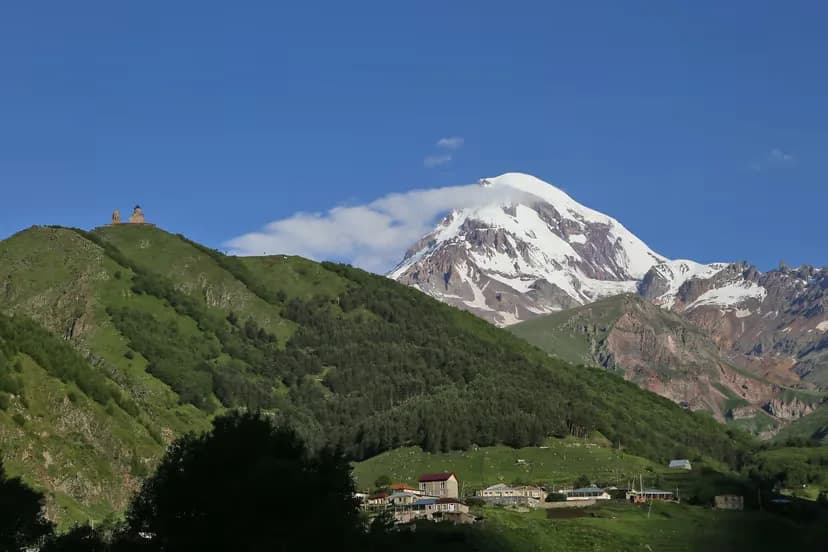
The town itself sits at 1,740 metres in the Terek River valley, surrounded by peaks that rise to 4,000 and 5,000 metres. Mount Kazbek at 5,047 metres dominates the northern horizon at all times — a constant reference point that makes navigation feel intuitive even without a map. The Gergeti Trinity Church on its 2,170-metre promontory is visible from the valley floor, which means your destination is literally in sight from the moment you start walking.
Distance: 4km round trip Elevation gain: 500 metres Time: 2.5-3.5 hours up, 1.5-2 hours down Difficulty: Moderate — appropriate for most beginners with basic fitness Best season: May through October
This is the trail that defines Kazbegi for most visitors, and it earns its reputation. The path begins at the northern edge of Stepantsminda village and climbs consistently — no false flats, no technical sections, no navigation challenges — through alpine meadow to the 14th-century church at the top.
The trail surface is a mix of compacted earth, loose gravel, and occasional rock steps. It's steep enough throughout to require steady breathing and deliberate pacing, particularly in the lower section where the gradient is most pronounced. At around the halfway point, the valley comes fully into view below — the town, the river, the highway threading north — and the sense of height and exposure begins.
The upper section flattens briefly as you approach the church promontory, and then the view opens completely: Mount Kazbek filling the northern sky, the church ahead, the valley 500 metres below on three sides. Most hikers stop walking at this point, not from tiredness but from the need to simply look.
The church itself is beautiful and austere — 14th century, still active, still devotional in atmosphere. Candles burn inside. The smell of old stone and incense. Services are held regularly; if you arrive during one, stand quietly at the back and observe. It is one of the most affecting experiences Georgia offers.
Coming down, the same trail reveals different angles — the valley floor comes into view in sections, the mountain shifts perspective with each turn in the path, and the knee-testing descent delivers you back to the village in considerably less time than the climb.
Guide tip: Start before 9am if possible. The morning light on Kazbek is extraordinary and the trail is quieter. By 11am in peak season, the upper section is busy.
Distance: 5km round trip Elevation gain: 150 metres Time: 2 hours Difficulty: Easy — suitable for all fitness levels including families with young children Best season: April through July (peak waterfall flow), but beautiful year-round
North of Kazbegi town, the Gveleti Gorge cuts deep into the mountain wall — a narrow canyon of dark rock where the Gveleti River drops in a series of cascades before joining the Terek. The walking trail follows the gorge from the road to the main waterfall complex, with minimal elevation gain and consistently dramatic scenery.
The gorge itself is the experience here as much as the destination. Vertical rock walls rise on both sides, in places no more than 30 metres apart. The river is loud and fast — fed by snowmelt from the peaks above, particularly powerful in May and June when the flow is at its strongest. The scale of the rock makes the path feel genuinely adventurous without being technically demanding.
The main waterfall at the trail's end drops approximately 20 metres into a shallow plunge pool. In peak flow, the spray is extensive — waterproof layers recommended if you want to approach closely, which you do.
This trail is the right choice for: families with children under 8, travelers with mobility limitations that preclude the Gergeti climb, anyone wanting a morning walk before tackling Gergeti in the afternoon, and hikers who want to guarantee a spectacular experience regardless of weather at altitude.
Distance: 8km one way Elevation gain: 900 metres Time: 4-5 hours Difficulty: Moderate-challenging — for beginners with good fitness wanting a longer day Best season: June through September
This is the Kazbegi trail that most guidebooks don't feature prominently, which is precisely why it belongs here. Starting from the village of Arsha, 3km south of Stepantsminda, this route approaches Gergeti Trinity Church from the east via a longer ridge traverse that reveals angles of the mountain and valley that the standard trail never shows.
The route is less obvious than the main Gergeti path and requires a guide — the ridge section in particular involves route-finding that benefits significantly from local knowledge. But for a beginner hiker who has already done Gergeti and wants a longer, more challenging day that feels genuinely exploratory, this is the natural progression.
The views from the eastern ridge are, arguably, superior to those from the main trail — a wider panorama that includes both the Terek valley to the north and the Aragvi headwaters to the south, with Kazbek increasingly prominent as you climb.
Where Kazbegi is Georgia's most accessible mountain destination, Svaneti is its most mysterious. Tucked into the northwestern Greater Caucasus, historically isolated to the point of developing its own dialect, its own architectural tradition, and its own cultural logic entirely separate from lowland Georgia, Svaneti operates at a different frequency from anywhere else in the country.
The landscape is more severe than Kazbegi — deeper valleys, denser forests, more heavily glaciated peaks. The famous Svan towers rise from village clusters throughout the region, medieval defensive structures that speak of a history defined by clan warfare and external invasion. The peaks above Mestia and Ushguli include some of the most dramatic summits in the Caucasus — Ushba, the double-summited "Matterhorn of the Caucasus," is a presence that dominates the landscape in a way that even Kazbek doesn't quite match.
For beginners, Mestia is the entry point. Flights from Tbilisi take 45 minutes and land at a small airport perched above the town. The town itself has comfortable guesthouses, several excellent restaurants, and a small but excellent national park museum that provides essential context for the landscape and culture you're about to walk through.
Distance: 12km round trip Elevation gain: 1,000 metres Time: 5-7 hours Difficulty: Moderate-challenging — the most demanding trail in this guide, but within reach of fit beginners Best season: June through October
The Koruldi Lakes sit at 2,700 metres on a hanging plateau above Mestia, in a bowl of alpine terrain that looks directly at nine peaks over 4,000 metres. Ushba — the double-summited nightmare that has defined Svaneti's mountaineering reputation for over a century — fills the southeastern horizon. On a clear morning, before the afternoon clouds build, the panorama from the lakeshore is one of the finest mountain views in the Caucasus.
This is genuinely the most demanding hike in this guide, and honesty matters: 1,000 metres of elevation gain over 6km is significant effort for a beginner. The trail is well-marked and non-technical throughout, but it requires stamina and appropriate pacing. Start early — the walk to the lakes takes 3-4 hours, and the descent another 2-3 hours, so a 7am start is sensible.
At the top: three small lakes, still and reflective in the morning silence, with the mountain panorama arranged behind them like something from a landscape painting. Most hikers sit here for an hour. The difficulty of the ascent is present in every moment of sitting — not as regret, but as satisfaction.
Guide note: This trail is significantly more enjoyable and safer with a guide, particularly for the upper section above the treeline where weather can change quickly and route-finding is less obvious.
Distance: 3km Elevation gain: Minimal Time: 1.5-2 hours Difficulty: Easy Best season: Year-round
For arrival days, recovery days, or travelers who want cultural hiking — the kind that builds understanding rather than altitude — a guided walk through Mestia's old town and tower district is deeply rewarding and completely underrated.
Mestia has over 200 Svan towers within the town and its immediate surroundings — medieval defensive structures built between the 9th and 13th centuries, rising 20-25 metres from family compounds, used both against external invaders and rival clans in a culture where blood feuds were institutionalized and towers were the architecture of survival.
Walking through the old quarter with a knowledgeable guide transforms what might appear to be picturesque ruins into a coherent story — the feudal structure of Svan society, the specific families who built specific towers, the battles that scarred the landscape, and the extraordinary fact that several towers are still inhabited by the descendants of the families that built them.
Several interiors are accessible; the climb to the top of an inhabited tower, with the Svaneti landscape spread in every direction, is worth the modest effort entirely.
Distance: 45km one way Elevation gain: Significant, spread over 3-4 days Time: 3-4 days Difficulty: Moderate — long but non-technical Best season: June through September
Ushguli sits at 2,200 metres at the head of the Enguri River valley — one of the highest permanently inhabited villages in Europe, a UNESCO World Heritage site, and a place so remote that until recently it was cut off by snow for five months of every year.
The walk from Mestia to Ushguli is the classic Svaneti multi-day route, and it belongs in this guide because — despite its length — it remains within the reach of a fit beginner willing to commit to three or four days on the trail. The terrain is never technically difficult. The gradient is manageable. The villages along the route offer simple but genuine guesthouse accommodation and meals.
What makes this route exceptional is the progressive revelation of Svaneti's landscape and culture over multiple days. Each valley turn brings a new tower cluster, a new mountain profile, a new section of ancient trail. By the time you reach Ushguli — the towers rising above the village against the glaciated face of Shkhara at 5,193 metres — the distance traveled feels both significant and earned.
This route is best done with a guide and pre-arranged guesthouse accommodation. DayTourGuides.com can arrange the full supported itinerary including guide, accommodation, meals, and luggage transfer between guesthouses. [→ Ask about our Mestia to Ushguli guided trek]
Kazbegi and Svaneti absorb the majority of Georgia's hiking visitors, and deservedly so. But several other regions offer trails of equal quality with dramatically fewer people on them.
Tusheti, in the northeastern Greater Caucasus, is accessible by road only during summer months — a single mountain track of legendary difficulty crosses the Abano Pass at 2,926 metres to reach the valley below. The isolation has preserved Tusheti almost completely: traditional stone towers, ancient churches, nomadic shepherd culture, and landscapes of extraordinary wildness.
For hikers willing to make the effort to get there, Tusheti offers multi-day routes through a region that feels genuinely unexplored compared to Kazbegi or Svaneti. The difficulty is real — this is not beginner territory in the standard sense — but guided day hikes from the main village of Omalo are accessible for any reasonably fit traveler.
In central Georgia, the Borjomi-Kharagauli National Park protects a vast area of Caucasian mixed forest, alpine meadow, and river valley that offers a completely different hiking experience from the high-altitude drama of Kazbegi and Svaneti. The trails here are gentler, the landscape more enclosed, the wildlife more visible — brown bears, wolves, Caucasian deer, and over 150 bird species inhabit the park.
For travelers whose primary interest is nature rather than altitude, or who want a contrast to the exposed mountain hiking of Kazbegi, Borjomi-Kharagauli is an excellent and undervisited option.
Getting the gear right is the difference between a comfortable, enjoyable day in the mountains and a miserable one. The list for Georgia is not complicated or expensive.
Footwear: This is non-negotiable. Trail running shoes with decent grip or light hiking boots with ankle support — either works well on Georgia's mountain trails. Regular trainers lack the grip and support the terrain requires. Do not hike Gergeti or Koruldi in sandals or fashion sneakers. It happens every season. It does not go well.
Layers: Mountain weather in Georgia changes with little warning. A sunny morning at 1,700 metres can become a cold, windy afternoon at 2,500 metres within a single hike. A lightweight waterproof jacket and a mid-layer fleece together weigh almost nothing and have rescued countless days. Never leave the valley floor without them.
Water: Carry at least 1.5 litres per person for a half-day hike, 2.5 litres for a full day. Georgia's mountain streams are generally clean and your guide can advise on safe water sources if you need to refill, but starting with adequate water eliminates the question entirely.
Sun protection: At 2,000+ metres, UV exposure is substantially higher than at sea level — the atmosphere is thinner and the angle of incidence is more direct. Sunscreen, sunglasses, and a hat are genuinely necessary in summer months, not optional comfort items.
Trekking poles: Not essential for any trail in this guide, but worth considering for the descents if you have knee concerns. Light collapsible poles add minimal pack weight and significantly reduce knee strain on steep downhills like the Gergeti descent.
A small daypack: 20-25 litres is sufficient for a full day hike — enough for layers, water, food, camera, and first aid basics. Nothing larger is necessary for the trails in this guide.
The honest case for guided hiking in Georgia goes beyond navigation. Yes, your guide knows the trails — but that's the least of what they provide.
Safety judgment. Mountain weather is the biggest variable in Georgia hiking, and the decision of when to continue and when to turn back requires local knowledge and experience. A guide who has watched Kazbegi weather patterns for years makes better decisions faster than a beginner with a weather app.
Medical preparedness. Professional guides carry first aid equipment and have wilderness first aid training. They know the fastest descent routes if someone needs to come down quickly. That knowledge has genuine value that only becomes apparent in the rare situations that require it.
Cultural context. The landscape of Georgia's mountains is inseparable from the history embedded in it — the churches, the towers, the shepherd routes, the clan territories, the Soviet-era interventions. A guide who can explain what you're looking at while you're looking at it transforms the experience from a physical achievement into something more layered and lasting.
Local access. Some of the best moments on Georgia's mountain trails happen off them — a spontaneous invitation to a shepherd's hut for tea and bread, a shortcut through a farm that opens onto an unmarked viewpoint, a conversation made possible by a guide's language and relationships. These moments cannot be planned. They happen with guides who know the territory and the people in it.
For your first hiking experience in Georgia, go with a guide. The trails will still be there for independent exploration on your return visit.
How fit do I need to be to hike in Kazbegi? For the Gergeti Trinity Church trail — the signature Kazbegi hike — a moderate level of general fitness is sufficient. If you can climb 10-15 flights of stairs without stopping to rest, you can hike Gergeti at a slow, steady pace. The elevation gain is real and will require effort, but it is not beyond the reach of most healthy adults. Go slowly, breathe consistently, and trust your guide's pace.
Can I do the Kazbegi hike and be back in Tbilisi the same evening? Yes, comfortably. A private Kazbegi day trip with pickup from your Tbilisi hotel, including the Gergeti hike, Mtskheta and Ananuri stops, and lunch in Kazbegi, typically returns to Tbilisi between 7:00-8:30pm. See our Kazbegi hiking day tours
Is Svaneti accessible as a day trip from Tbilisi? Not practically — the journey to Mestia is either a 7-8 hour drive or a 45-minute flight, making it a minimum two-night destination. This is not a disadvantage: Svaneti rewards time, and two or three nights there is one of the finest travel experiences Georgia offers
What happens if it rains on my hiking day? Light rain is common in Georgia's mountains and does not prevent hiking — it simply requires waterproof layers and appropriate footwear. Heavy rain or lightning changes the calculation: your guide will assess conditions and make the call on whether to proceed, modify the route, or reschedule. DayTourGuides.com offers free rescheduling for weather cancellations on private tours.
Are Georgia's mountain trails marked? The main Kazbegi trails are reasonably well-marked. Svaneti trails vary — the Koruldi Lakes trail is marked, the Mestia-Ushguli route is well-established but signage is inconsistent. Off the main tourist routes, marking is sparse and local knowledge matters significantly. This is one of the strongest practical arguments for guided hiking in Georgia.
Written by Author
Author