
Georgian Food Guide: 12 Dishes You Must Try on Your Trip
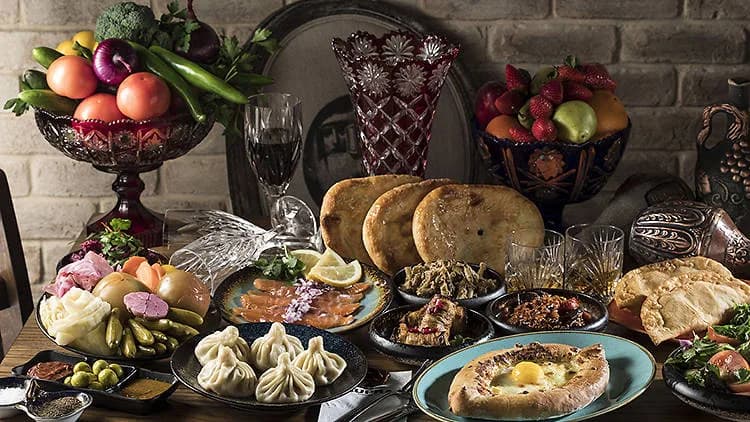
There is a moment that happens to almost every first-time visitor to Georgia. It occurs somewhere between the first bite of freshly baked khachapuri and the second glass of amber wine, usually in a small restaurant with exposed stone walls and a table that keeps accumulating dishes nobody ordered but everyone is glad arrived.
The moment is the realization that Georgian food is something special — not just good, not just interesting, but genuinely unlike anything else in the world.
Georgia sits at the crossroads of Europe, Asia, and the Middle East, and its cuisine reflects every influence while remaining defiantly, unmistakably its own. Walnuts, pomegranate, tarragon, fenugreek, wild plums, churchkhela, amber wine fermented in clay — this is a food culture of extraordinary depth and personality.
Here are the 12 dishes every visitor to Georgia must try, and what makes each of them worth seeking out.
1. Khachapuri — Georgia's Defining Dish
If there is one dish that defines Georgian food in the global imagination, it is khachapuri — a cheese-filled bread that exists in several regional variations, each fiercely defended by its home region.
Adjaruli khachapuri is the version that tends to stop visitors mid-sentence. Shaped like a boat, filled with molten sulguni cheese, and finished with a raw egg and a knob of butter stirred in at the table — it is simultaneously one of the most indulgent and most satisfying things you will eat anywhere.
Imeruli khachapuri is the everyday version — a round, flat bread with cheese baked inside. Simpler, quieter, and deeply comforting.
Megruli khachapuri adds cheese on top as well as inside. Because sometimes restraint is overrated.
Where to try it: Everywhere. Seriously. But seek out a bakery (purné) for the most authentic version, fresh from the tone (traditional clay oven).
2. Khinkali — The Art of the Dumpling
Khinkali are Georgia's famous soup dumplings — thick-doughed parcels filled with spiced meat (traditionally pork and beef) and a pool of intensely flavored broth that forms during cooking. The correct technique for eating them is non-negotiable: hold by the twisted topknot, bite a small hole, sip the broth first, then eat the rest. The topknot is left on the plate — a running count of how many you've eaten.
The mountain version (kalakuri khinkali) uses more herbs and is spicier. Mushroom and potato fillings exist for vegetarians. In Tbilisi's Old Town, competitive khinkali eating is practically a spectator sport.
Where to try it: Pasanauri village on the Georgian Military Highway serves legendary khinkali — a traditional stop on the Kazbegi tour route.
3. Mtsvadi — Georgian Shashlik
Mtsvadi is Georgia's version of shashlik — chunks of pork, beef, or lamb marinated and grilled over charcoal or, in the traditional Kakhetian method, over dried grapevine cuttings that impart a distinctive, faintly sweet smokiness to the meat.
Served with raw onion, pomegranate seeds, and tkemali (sour plum sauce), a well-made mtsvadi is one of the great simple pleasures of Georgian eating — best consumed outdoors, with good wine, among people you like.
Where to try it: Kakheti, where grapevine grilling is a point of local pride. Any roadside restaurant with visible charcoal smoke is a promising sign.
4. Pkhali — The Walnut Paste Appetizers
Pkhali are a category of cold appetizers made from finely chopped vegetables — spinach, beetroot, green beans, cabbage — mixed with ground walnuts, garlic, vinegar, and a blend of Georgian spices (khmeli suneli). They are typically shaped into small balls and topped with a pomegranate seed.
A plate of mixed pkhali arrives at almost every Georgian feast (supra) as part of the first wave of cold dishes. They are simultaneously light and intensely flavored — the walnut paste binds everything with a richness that makes each variety distinct despite the similar base.
Where to try it: Any traditional Georgian restaurant. A mixed pkhali plate is always the right order.
5. Badrijani Nigvzit — Eggplant with Walnut Paste
If pkhali represents the walnut paste principle applied to vegetables, badrijani nigvzit is its most elegant expression. Thin slices of fried eggplant are spread with a dense, garlicky walnut paste seasoned with fenugreek and coriander, then rolled and garnished with pomegranate seeds.
The contrast of the soft, yielding eggplant with the dense, aromatic paste is one of the great textural combinations in Georgian cuisine. It appears on virtually every supra table and disappears faster than almost anything else.
Where to try it: Any Georgian restaurant. It is impossible to order badly here.
6. Chakapuli — The Taste of Georgian Spring
Chakapuli is the dish that most clearly marks the Georgian spring, appearing on tables from March through May and eaten with particular enthusiasm at Easter. It is a stew of young lamb (or veal) cooked with an extraordinary quantity of fresh tarragon, white wine, sour plum (tkemali), and spring onions — a bright, herbaceous, wine-fragrant broth that tastes like the season itself.
If you are in Georgia in April, ordering chakapuli is not optional. It is a moral obligation.
Where to try it: Any traditional restaurant in spring. Ask specifically — it may not be on the printed menu but will almost certainly be available.
7. Lobiani — Bean-Filled Bread
Lobiani is khachapuri's earthier, more sustaining cousin — a round flatbread filled with spiced kidney beans rather than cheese. The beans are seasoned with smoked pork fat (lori), onion, and dried herbs, producing a filling that is simultaneously humble and deeply satisfying.
Lobiani is mountain food — the bread that sustained shepherds and travelers through Caucasian winters — and it is best eaten warm, straight from the oven, ideally at high altitude with cold mountain air outside.
Where to try it: Anywhere along the Georgian Military Highway toward Kazbegi. It is the ideal road-trip food.
8. Ojakhuri — The Georgian Family Feast in a Pan
Ojakhuri (literally "family dish") is a pan of fried potatoes and meat — typically pork — cooked together with onions and herbs until everything is golden and fragrant. It is unpretentious, comforting, and completely delicious.
It appears on virtually every Georgian restaurant menu and represents the everyday home cooking that sits beneath the more elaborate supra dishes. Order it when you want something honest and satisfying rather than ceremonial.
Where to try it: Any Georgian tavern (dukani). It is the reliable choice when you want something unfussy and good.
9. Satsivi — Cold Poultry in Walnut Sauce
Satsivi is one of Georgia's most complex and labor-intensive dishes — poached chicken or turkey served cold in a thick, golden walnut sauce spiced with cinnamon, cloves, turmeric, garlic, and fenugreek. The sauce is a feat of patient grinding and seasoning, and a well-made satsivi is extraordinarily rich and aromatic.
It is traditionally a winter and festive dish, often appearing at New Year and Christmas supras, but good Georgian restaurants serve it year-round. It pairs perfectly with Georgian white wine.
Where to try it: Traditional restaurants in Tbilisi's Old Town. Ask the server if it's made in-house — the quality difference between homemade and commercial satsivi is significant.
10. Churchkhela — Georgia's Ancient Energy Bar
Churchkhela is one of those foods that sounds unusual until you try it and then immediately buy three more to take home. Walnuts (or hazelnuts) are threaded onto a string, then repeatedly dipped into thickened, sweetened grape juice (tatara) and hung to dry — producing a dense, chewy, intensely flavored confection that has fueled Georgian travelers and soldiers for centuries.
They hang in colorful rows at every market and roadside stall in Kakheti, where the grape juice is freshest. The walnut version is the classic; hazelnut is more common in western Georgia.
Where to try it: Kakheti markets, particularly around Sighnaghi and Telavi. Buy directly from the producer if you can.
11. Shkmeruli — Chicken in Garlic Milk Sauce
Shkmeruli comes from the village of Shkmeri in the Racha region and has become one of Georgia's most celebrated regional dishes. A whole small chicken is roasted and then finished in a sauce of milk and an almost alarming quantity of garlic — the result is simultaneously rich, fragrant, and completely addictive.
It was briefly served on the International Space Station as part of a Georgian cultural promotion, which tells you something about its status in the national culinary imagination.
Where to try it: Racha-focused restaurants in Tbilisi, or any restaurant listing it as a specialty. It is worth seeking out specifically.
12. Tklapi — Sour Fruit Leather
Tklapi is perhaps the least internationally known item on this list and the one most likely to surprise you. Made from pureed sour plums (tkemali) or other tart fruits spread thin and dried in the sun, tklapi is Georgia's answer to fruit leather — intensely sour, concentrated, and used both as a snack and as a souring agent in cooking.
It represents a broader principle of Georgian cuisine: the love of sour, fermented, and preserved flavors that runs through everything from the wine to the condiments to the bread. Tasting tklapi is tasting something genuinely ancient — a flavor that has not fundamentally changed in centuries.
Where to try it: Markets in Tbilisi (Deserter's Market is the best), Kakheti, and western Georgia. Ask for it specifically.
The Georgian Supra: More Than a Meal
No food guide to Georgia is complete without mentioning the supra — the traditional Georgian feast that is less a meal than a social institution. Presided over by a tamada (toastmaster) who leads elaborate toasts to family, friendship, homeland, and the departed, a supra can last for hours and involve dozens of dishes arriving in waves.
Being invited to a Georgian family supra is one of the great travel experiences the country offers. If you visit a winery, a guesthouse, or a family home and the table starts filling with food, you are about to understand why Georgian hospitality has the reputation it does.
Pair It With Georgian Wine
Every dish on this list has a natural Georgian wine pairing. The general principles:
Amber/orange wines (qvevri-fermented whites like Rkatsiteli) pair beautifully with walnut-based dishes, cheese, and rich stews
Saperavi — Georgia's great red — holds up to mtsvadi, ojakhuri, and anything grilled
Dry white Mtsvane works well with lighter dishes and fresh herbs
Chacha (Georgian grape spirit) follows every meal whether you planned for it or not
🎯 Taste Georgia With a Local Guide
The best Georgian food is found in small family restaurants, village homes, and market stalls that no travel app will find for you. Our Food & Wine Tours combine Georgia's greatest culinary experiences with its most beautiful landscapes — guided by locals who know where the best table in every village is.
What's your favorite Georgian dish? Tell us in the comments — and if there's something we missed, we want to know.
Written by Author
Author