Wine & Gastronomy
A Complete Guide to Kakheti: Wine, History & Views
Author

Loading
Preparing your travel experience.
If Georgia is the cradle of wine — and the evidence strongly suggests it is, with winemaking traditions dating back 8,000 years — then Kakheti is its heartland.
Stretching east of Tbilisi toward the Alazani River and the foothills of the Greater Caucasus, this ancient region produces nearly 70% of all Georgian wine, contains some of the country's most significant medieval monasteries, and offers landscapes of such quiet beauty that travelers who come for a day often find themselves extending their stay.
This is your complete guide to Kakheti — what to see, what to drink, and how to make the most of every hour.
Kakheti occupies the eastern corner of Georgia, bordered by the Greater Caucasus to the north, the Alazani River and Azerbaijan to the east, and the Inner Kartli region to the west. The regional capital is Telavi, but most visitors also spend time in Sighnaghi, the region's most picturesque town.
From Tbilisi: 80–120 km depending on your destination | Drive: 1.5–2 hours via the E60 highway through the Gombori Pass, or the faster northern route through Rustavi.
Kakheti has been inhabited since the Bronze Age and has served as a distinct political entity — a kingdom, then a principality, then a region — for most of recorded Georgian history. It bore the brunt of repeated Mongol, Persian, and Ottoman invasions, yet its monasteries, fortresses, and wine culture survived them all.
The region's deep Christian identity is embodied in sites like Bodbe Monastery, where St. Nino — the woman who brought Christianity to Georgia in the 4th century — is buried, and Alaverdi Cathedral, one of the tallest medieval structures in the Caucasus.
Through invasion, occupation, Soviet collectivization, and post-independence revival, Kakhetian winemakers never stopped making wine. That continuity is part of what makes the region so compelling.
Georgian wine is unlike wine made anywhere else in the world, and Kakheti is where its most distinctive traditions are most alive.
The defining feature of traditional Georgian winemaking is the qvevri — a large clay vessel, sealed with beeswax, buried underground up to its neck. Grapes are fermented inside the qvevri with their skins, seeds, and stems for weeks or months, producing wines of extraordinary complexity and a deep amber color in whites.
This method is recognized by UNESCO as an Intangible Cultural Heritage of Humanity. When you drink an amber (or "orange") wine in Kakheti, you are participating in one of the world's oldest continuous culinary traditions.
Rkatsiteli — Georgia's most planted white variety. Versatile, high-acid, excellent in both qvevri and modern styles
Kakhuri Mtsvane — aromatic white, often blended with Rkatsiteli
Saperavi — Georgia's great red variety. Deep purple, full-bodied, with remarkable aging potential
Khikhvi & Kisi — rarer heritage varieties making a comeback among natural wine producers
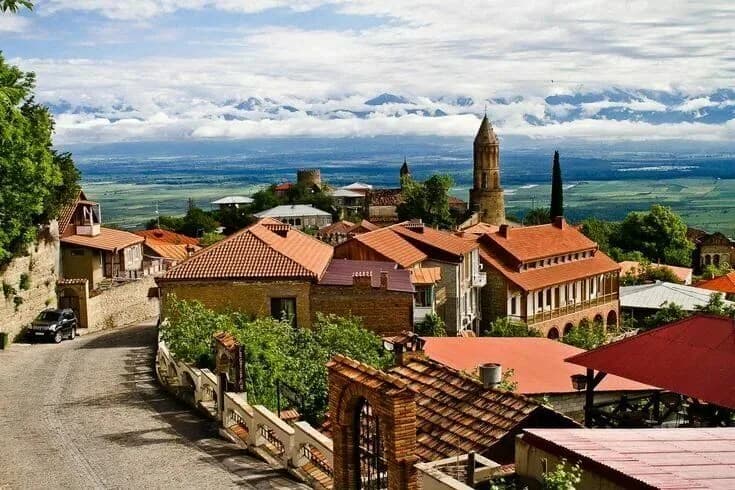
Perched on a hilltop above the Alazani Valley, Sighnaghi is Kakheti's most romantic town and one of the most visited destinations in Georgia. Its cobblestone streets, colorful balconied houses, and panoramic views across the valley to the snow-capped Caucasus make it immediately photogenic.
The town is enclosed by a restored 18th-century city wall with 23 towers — walk the full circuit for the best valley views. The central square is lined with wine bars and restaurants, and the Sighnaghi Museum houses an excellent collection of works by the Georgian primitivist painter Niko Pirosmani, who was born nearby.
Don't miss: Watching the sunset over the Alazani Valley from the city walls — one of Georgia's great travel moments.
Just 2 km from Sighnaghi, Bodbe Monastery is one of Georgia's most sacred pilgrimage sites — the burial place of St. Nino, the Cappadocian missionary who converted Georgia to Christianity around 327 AD. The monastery complex includes a beautiful walled garden, a 9th-century cathedral, and a steep path leading down through forested hillside to the miraculous healing spring in the gorge below.
The atmosphere here is genuinely moving — candlelit, quiet, and layered with centuries of devotion.
Dress code: Shoulders and knees must be covered. Headscarves for women are expected inside the church.
Rising improbably from the flat Alazani Valley floor, Alaverdi Cathedral was built in the 11th century and stands at 50 meters — making it one of the tallest medieval buildings in the entire Caucasus. The surrounding monastery complex is still active, and the monks here produce wine using traditional qvevri methods in the monastery's own cellar.
Visiting in the early morning, when the cathedral catches the first light against the backdrop of the Caucasus, is a special experience.
The ruins of the Gremi royal citadel, once the capital of the Kingdom of Kakheti in the 16th century, stand on a rocky hill near Kvareli. The Church of the Archangels within the complex is beautifully preserved, and the views from the tower across the valley are excellent.
The former estate of Alexander Chavchavadze — Georgian poet, diplomat, and one of the founders of modern Georgian wine culture — Tsinandali is now both a historic museum and a working winery. The estate's formal gardens are lovely in spring, and the wine cellar contains bottles dating back to the 1800s, making it one of the oldest continuously operating wine cellars in the world.
Kakheti has hundreds of wineries, from large commercial operations to tiny family cellars. These are some of the most visitor-friendly:
Winery | Style | Known For |
|---|---|---|
Twins Wine House | Family, modern | Excellent tastings, beautiful setting |
Shumi Winery | Traditional + modern | Large qvevri cellar, great tours |
Schuchmann Wines | European-style | Consistent quality, English-speaking staff |
Tsinandali Estate | Historic | Heritage wines, beautiful gardens |
Pheasant's Tears | Natural / qvevri | Sighnaghi-based, beloved by wine geeks |
Jakeli Wines | Small family | Authentic, off-the-beaten-path experience |
Tip: Most wineries appreciate advance notice for visits, especially in April when spring tourism begins to pick up.
Kakheti has its own distinct culinary identity within Georgian cuisine:
Mtsvadi — Georgian-style shashlik, grilled over grapevine cuttings for a distinctive smoky flavor. The best in the country is found in Kakheti.
Kakhetian khinkali — slightly different from Tbilisi's version, with a more robust filling and thicker dough
Badrijani nigvzit — fried eggplant rolls filled with walnut paste and garlic, an indispensable Georgian starter
Churchkhela — strings of walnuts dipped in thickened grape juice and dried, sold everywhere in Kakheti and impossible to resist
Fresh cheese with honey — simple, perfect, local
A single day in Kakheti requires some planning to avoid spreading yourself too thin. Here's a suggested itinerary:
7:30am — Depart Tbilisi 9:30am — Arrive Sighnaghi, walk the city walls, visit Niko Pirosmani Museum 11:00am — Bodbe Monastery and healing spring 12:30pm — Winery visit and lunch (Pheasant's Tears or Twins Wine House) 2:30pm — Alaverdi Cathedral or Tsinandali Estate 4:30pm — Wine tasting at a second winery or family cellar 6:00pm — Depart for Tbilisi 8:00pm — Arrive Tbilisi
This itinerary works best with a guided tour — your guide knows which wineries are open, where to eat authentically, and how to time the drive over the Gombori Pass for the best views.
April is one of the best months to visit Kakheti. The vineyards are showing their first green shoots, fruit trees are in blossom across the valley floor, and the Alazani Valley has the kind of luminous, fresh quality that summer heat later strips away.
Temperatures in Sighnaghi in April average 12–18°C — ideal for walking. The valley views are at their clearest before summer haze sets in.
The difference between a self-drive Kakheti trip and a guided tour is the difference between reading a wine label and talking to the winemaker. Our Kakheti guides know the region's history, speak the language, and know which family cellar will give you the most authentic tasting of your trip.
👉 Book Your Kakheti Wine Tour →
Have a question about visiting Kakheti? Ask us in the comments — our local experts answer every one.
Written by Author
Author