Canyons & Nature
Martvili Canyon & Prometheus Cave: Western Georgia's Wonders
Author

Loading
Preparing your travel experience.
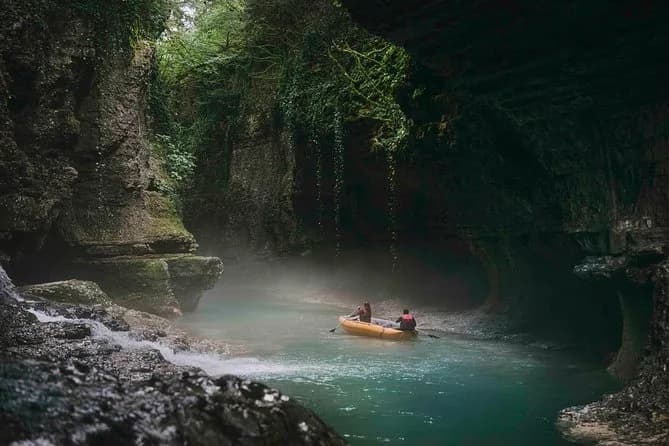
Georgia's eastern highlights — Tbilisi, Kazbegi, Kakheti — tend to dominate the conversation. Understandably so. But travelers who venture west discover a completely different Georgia: lusher, wetter, more subtropical, shaped by rivers and limestone rather than volcanic peaks and semi-arid steppe.
And in western Georgia, two natural attractions stand apart.
Martvili Canyon — a series of emerald gorges carved by the Abasha River through ancient limestone, navigable by boat through chambers of extraordinary color and silence.
Prometheus Cave — a vast underground world of stalactites, stalagmites, underground rivers, and illuminated chambers stretching nearly 1.5 kilometers into the earth near Kutaisi.
Together, they make one of the finest full-day excursions available anywhere in Georgia — and remain, remarkably, less visited than they deserve.
Both attractions are located in western Georgia's Samegrelo-Zemo Svaneti region, roughly 300–320 kilometers west of Tbilisi near the city of Kutaisi.
Martvili Canyon | Prometheus Cave | |
|---|---|---|
Distance from Tbilisi | ~300 km | ~220 km |
Distance from Kutaisi | ~55 km | ~20 km |
Drive from Tbilisi | ~3.5–4 hours | ~2.5–3 hours |
Visit duration | 1.5–2.5 hours | 1–1.5 hours |
The logical approach is to combine both in a single long day trip from Tbilisi, or to base yourself in Kutaisi overnight and visit each more leisurely. A guided tour that handles the logistics — including the boat at Martvili and the cave tour at Prometheus — makes the most sense for a day trip of this distance.
Martvili Canyon (also spelled Martville) is a series of gorges carved by the Abasha River through a plateau of ancient limestone in the Samegrelo region. The canyon walls rise up to 40 meters on either side, their surfaces draped in moss, ferns, and hanging vegetation fed by the perpetual mist of the waterfalls above.
The water of the Abasha flowing through the canyon is a color that defies easy description — a shifting turquoise-green-blue that changes with the angle of light and the season, at its most intense and vivid in spring and early summer when snowmelt feeds the river at full volume.
The primary experience at Martvili is a guided boat ride through the lower sections of the canyon — a 20–30 minute journey in a small wooden boat paddled by a local guide through a sequence of chambers, past waterfalls cascading directly into the water, beneath overhanging limestone walls, and through passages so narrow the canyon walls seem almost within arm's reach on either side.
The light inside the canyon varies dramatically with the time of day. Midmorning typically offers the best combination of direct sunlight into the upper sections and reflected light illuminating the water's color. Early afternoon can bring stronger overhead light that flattens the color; early morning in spring, with mist still rising from the water, is magical.
The boat ride is genuinely unmissable. The walkway above the canyon offers good views, but the experience of being at water level — hearing the waterfalls, feeling the spray, watching the canyon walls rise above you — is in a different category entirely.
Above the boat section, a walking path follows the canyon rim through forest, passing a series of waterfalls and lookout points. The walk takes 45–60 minutes at a comfortable pace and offers both aerial views into the gorge and access to smaller side waterfalls where the light through the canopy in spring is exceptional.
In April, the surrounding forest is at its freshest green — the combination of the turquoise water below and the vivid spring foliage above makes Martvili arguably more beautiful in spring than at any other time of year.
Opening hours | 10:00am – 6:00pm (seasonal variations) |
Entry fee | ~15 GEL (~$5) |
Boat ride | ~20 GEL (~$7) additional — book at entrance |
What to wear | Expect to get wet — waterproof jacket recommended, change of shoes useful |
Facilities | Parking, toilets, small café at entrance |
Photography | Bring a waterproof case or bag for your phone/camera on the boat |
Accessibility | Canyon walk is moderate — some uneven steps; boat accessible to most visitors |
Pro tip: Arrive at opening time (10am) to get on the first boats before queue forms. By midday in summer the wait for boats can be significant. In April, queues are minimal.
Prometheus Cave (Promethe's Mghvime in Georgian) is the largest cave open to the public in Georgia and one of the most spectacular show caves in the entire Caucasus region.
Named after the Titan of Greek mythology who, according to some traditions, was chained to a rock in the Caucasus as punishment for giving fire to humanity, the cave system was discovered in 1983 and opened to visitors in 2010. It stretches for over 22 kilometers in total — the tourist route covers approximately 1,400 meters through six distinct chambers.
The cave was formed over millions of years by the action of underground rivers dissolving the surrounding limestone, creating a sequence of chambers of extraordinary scale and variety.
Chamber 1 — The Hall of Stalactites: The entrance chamber introduces the cave's defining feature — thousands of stalactites hanging from the ceiling in formations ranging from delicate translucent needles to massive columns formed over hundreds of thousands of years. The largest stalactite in the cave measures over 3 meters.
Chamber 2 — The Coral Hall: Named for the coral-like formations covering the walls and floor — technically called cave coral or cave popcorn, formed by calcite-rich water seeping through the rock surface. The texture and density of these formations here is exceptional.
Chamber 3 — The Organ Hall: The largest chamber in the cave system — a vast underground space where the stalactites hanging from the high ceiling create a visual impression of a massive pipe organ. The scale here is genuinely impressive — you stand in a space that took geological time to create.
Chamber 4 — The Wedding Hall: So named for its popularity as a venue for underground wedding ceremonies — yes, people genuinely get married here. The formations are particularly dramatic, with large stalactite-stalagmite columns meeting in the center of the chamber.
Chamber 5 — The Speleothem Gallery: A more intimate chamber with a high concentration of rare speleothem formations — helictites (formations that grow in defiance of gravity, curling and branching in seemingly random directions), cave pearls (small calcite spheres formed in pools of dripping water), and cave shields (flat disc-shaped formations projecting from the walls).
Chamber 6 — The Underground River Exit: The tour concludes at the cave's underground river, where visitors board a small boat for the final section of the journey — floating through a low-ceilinged passage with the river flowing beneath and formations hanging above, exiting the cave by water. This boat exit is one of the highlights of the Prometheus experience and makes it genuinely unique among Georgia's cave attractions.
The cave is illuminated throughout with colored lighting — a feature that divides visitors fairly cleanly into those who find it dramatically effective and those who prefer their caves unlit. The colors do highlight formations that would otherwise be difficult to see in the cave's natural darkness, and the blue-lit underground river section is genuinely atmospheric.
Opening hours | 10:00am – 6:00pm daily |
Entry fee | ~23 GEL (~$8), including boat exit |
Tour duration | ~60–75 minutes (guided tour, set departure times) |
Temperature inside | ~14°C year-round — bring a light layer regardless of outside temperature |
Photography | Permitted throughout; a wide-angle lens helps in larger chambers |
Accessibility | Paved paths throughout; manageable for most visitors; boat exit requires stepping into a small boat |
Languages | Tours available in Georgian, Russian, English |
Pro tip: The cave tour runs on set departure times with guides — check the schedule on arrival and time your Martvili visit accordingly to avoid waiting.
6:30am — Depart Tbilisi (early start essential for a full day) 9:30am — Arrive Martvili Canyon. First boat of the day, upper canyon walk 12:00pm — Lunch near Martvili or en route to Kutaisi (local Megrelian restaurants are excellent — try Megrelian khachapuri and gebzhalia) 2:00pm — Arrive Prometheus Cave. Join guided tour 3:30pm — Depart Prometheus Cave 4:00pm — Optional: brief stop in Kutaisi (Bagrati Cathedral, Gelati Monastery — both UNESCO sites) if energy allows 7:00–8:00pm — Return to Tbilisi
Total driving: ~7 hours | Total time out: ~13–14 hours
This is a long day — comfortable in a private car with a guide, exhausting if self-driving unfamiliar roads for the first time.
If you're traveling this far west, Kutaisi deserves at least a few hours. Georgia's second-largest city is far less visited than Tbilisi and correspondingly more authentic in feel.
Bagrati Cathedral — an 11th-century UNESCO-listed cathedral on a hilltop above the city, partially reconstructed after being blown up by the Ottomans in 1692. The ruins and the restoration coexist in an architecturally complex and historically rich site.
Gelati Monastery — arguably the finest medieval monastery complex in Georgia, built by King David the Builder in 1106 as a center of learning and culture. The mosaics inside the Church of the Virgin are extraordinary. King David himself is buried at the monastery's gate — by his own request, so that everyone who entered would walk over him.
Kutaisi Green Bazaar — the city's central market, more authentic and less tourist-oriented than Tbilisi's equivalents. Excellent for local Megrelian food products.
Travelers who have only seen eastern Georgia are often surprised by how different the west feels.
Eastern Georgia | Western Georgia | |
|---|---|---|
Landscape | Semi-arid, open valleys, steppe | Subtropical, forested, lush |
Climate | Drier, more continental | Wetter, more humid |
Wine tradition | Qvevri amber wines, Saperavi | Lighter wines, Adjarian and Megrelian styles |
Food | Kakhetian mtsvadi, khinkali | Megrelian khachapuri, gebzhalia, chirbuli |
Architecture | Fortified towers, cave cities | Medieval monasteries, coastal fortresses |
Feel | Ancient, austere, dramatic | Green, fertile, subtropical |
Both are extraordinary. Together they make Georgia one of the most varied countries in Europe for its size.
Spring is the single best time to visit Martvili Canyon, and it is not particularly close.
The snowmelt from the Samegrelo highlands feeds the Abasha River at its maximum volume in April and May, producing the deepest, most saturated turquoise color in the canyon water and filling the waterfalls to their most dramatic state. The surrounding forest has just completed its spring flush — the green of the vegetation above the canyon in April is a shade that photographers spend years trying to capture accurately.
By summer, water levels drop and the color, while still beautiful, is less intense. By autumn, the surrounding forest turns gold but the water volume is lower. In winter, the canyon can be partially inaccessible.
April is the peak of Martvili's beauty — which makes it all the more remarkable that visitor numbers in April remain a fraction of the summer peak.
The logistics of combining Martvili Canyon and Prometheus Cave — timing the boat, the cave tours, the driving, and optional Kutaisi stops — are exactly what a guided day tour handles seamlessly. Our Western Georgia day tours from Tbilisi cover everything, with an expert local guide who knows the region's history, food, and hidden stops along the way.
👉 Book Your Western Georgia Tour →
Have you visited Martvili or Prometheus Cave? Tell us what surprised you most in the comments below.
Written by Author
Author