Adventure & Extreme
Svaneti: Towers, Trails & Timeless Beauty in the Caucasus
Author

Loading
Preparing your travel experience.
There are places in the world that feel genuinely apart — not just geographically remote, but culturally, historically, and atmospherically distinct from everything around them. Places where the modern world has arrived but not quite taken hold, where the landscape is so dramatic it shapes the people who live in it, where you feel the weight of unbroken continuity with a past that elsewhere has been paved over or forgotten.
Svaneti is one of those places.
Tucked into the highest inhabited valleys of the Greater Caucasus in northwestern Georgia, Svaneti is a region of medieval defensive towers, glacial peaks rising above 5,000 meters, ancient polyphonic music, unique language, and a culture that survived centuries of isolation by becoming, in some ways, isolation itself.
It is also one of the most breathtaking landscapes on the European continent. And it is, still, one of the most undervisited.
Svaneti occupies the upper Enguri River valley in northwestern Georgia, bordering Russia's North Caucasus to the north. The regional capital is Mestia — a small town of around 2,500 people sitting at 1,500 meters above sea level, surrounded on all sides by peaks exceeding 4,000 meters.
Beyond Mestia, the road continues another 45 kilometers to Ushguli — a cluster of four villages at 2,200 meters that holds the distinction of being the highest permanently inhabited settlement in Europe.
Distance from Tbilisi | ~430 km |
Drive time | ~5.5–6 hours via Kutaisi |
Flight time | ~40 minutes (Tbilisi to Mestia, seasonal flights) |
Best season | June–October for hiking; December–March for skiing |
Regional capital | Mestia |
Famous for | Svan towers, Ushguli, hiking, skiing, polyphonic music |
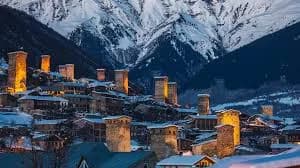
Nothing defines the Svaneti landscape more immediately than its towers.
Across the region, more than 200 medieval defensive towers rise above the villages — square stone structures standing between 20 and 28 meters tall, built between the 9th and 13th centuries as combined defensive fortifications and family refuges during the blood feuds and external invasions that characterized Svaneti's medieval history.
The towers are extraordinary for several reasons. First, their construction quality — built without mortar in many cases, using only locally quarried stone fitted with a precision that has allowed them to stand for nearly a millennium in a seismically active, heavily snowloaded mountain environment. Second, their density — in the village of Chazhashi (part of the Ushguli cluster), more than 30 towers rise from a settlement of fewer than 100 households, creating a skyline unlike anything else in Europe. Third, their living context — many towers remain in active family ownership, still attached to the family homes they were built to protect.
UNESCO recognized the Upper Svaneti landscape as a World Heritage Site in 1996, citing both the towers and the natural environment surrounding them.
Mestia has changed significantly in the past decade. Investment in tourism infrastructure — a new airport, improved roads, a ski resort, boutique guesthouses — has made it accessible without (yet) making it overtouristed. It remains a genuinely small mountain town where the guesthouse owner likely knows your guide and the best restaurant is probably someone's kitchen.
Svaneti History Museum The Mikheil Khergiani House-Museum and the central Svaneti Museum of History and Ethnography together hold one of the most remarkable collections of medieval Georgian art outside Tbilisi — icons, crosses, manuscripts, and liturgical objects that were hidden in Svaneti during invasions and survived precisely because of the region's remoteness. The medieval enamel and gold work here is extraordinary.
The Tower Walk Mestia's own cluster of towers is walkable from the town center. Several are open to visitors and can be climbed — the views from the upper levels over the town and surrounding peaks reward the effort considerably.
Chalaadi Glacier Trail One of Mestia's most accessible hikes leads to the Chalaadi Glacier — a 3–4 hour round trip through beech and pine forest to the glacier's snout, where the ice meets the moraine in a landscape of blue-grey stone and meltwater streams. No technical equipment required; good walking shoes and layers are sufficient.
Mestia to Zhabeshi Walk A gentler valley walk following the Mulkhura River through meadows and small villages, passing towers and traditional Svan farmhouses. Excellent for an easy half-day with big mountain views.
Hatsvali Ski Resort In winter and early spring, Hatsvali — the ski area above Mestia — offers uncrowded skiing with the Caucasus massif as a backdrop. The season typically runs December through March, with April sometimes still offering spring skiing conditions on higher pistes.
If Mestia is where most visitors stop, Ushguli is where Svaneti reveals its full depth.
The road from Mestia to Ushguli takes 1.5–2.5 hours depending on conditions — a rough track through river gorges and over ridges that requires a 4x4 and a driver who knows it. The journey itself is part of the experience: the valley narrows, the peaks close in, the villages grow smaller and more ancient-feeling, and by the time you arrive at Ushguli you have the sense of having traveled not just in distance but in time.
Ushguli is actually four villages — Chvibiani, Chazhashi, Murkmeli, and Zhibiani — clustered together on a promontory above the Enguri River at 2,200 meters. The tower concentration here is the highest in Svaneti. The Church of the Queen Tamar at the upper end of Chazhashi village contains medieval frescoes of remarkable quality. And from the edge of the village, on a clear day, the north face of Mount Shkhara — at 5,068 meters the highest peak entirely within Georgia — fills the horizon so completely it seems impossible.
The Shkhara Glacier viewpoint, reachable by a 2–3 hour hike from Ushguli through flower-filled meadows, offers the closest accessible view of the glacier and the peak above it. This hike, in July and August when the wildflowers are at their peak, is one of the finest mountain walks in all of Georgia.
Practical note: Ushguli can be visited as a day trip from Mestia, but an overnight stay — in one of the simple guesthouses operated by local families — allows you to experience the village at dawn and dusk when the light on the towers and peaks is extraordinary and the day-trip visitors have gone.
For serious hikers, the Mestia to Ushguli multi-day trek is one of the great walking routes in the Caucasus.
The route takes 4–5 days, traversing high passes and remote valleys between Mestia and Ushguli rather than following the road. Highlights include:
Koruldi Lakes (2,700m) — alpine pools with a 360-degree Caucasus panorama on day one
Tsvirmi and BogrAnniversary passes — high crossings with views into both Georgia and the Russian North Caucasus
Remote villages — Adishi, Iprali, Khe — each with towers, churches, and guesthouses operated by local families
Adishi Glacier crossing — the most dramatic section of the route, fording the glacier meltwater river (guide essential, timing critical)
The trek is graded moderate-difficult — no technical climbing required, but high daily elevation gains, river crossings, and remote conditions mean good fitness, proper equipment, and an experienced local guide are all essential.
Best months: July–September. The passes can hold snow into June and become difficult in October.
Svaneti is not simply a remote part of Georgia. It is, in many meaningful ways, its own cultural world.
Svan (Lushnu nin) is a South Caucasian language related to but mutually unintelligible with Georgian — a language that has been spoken in these valleys for at least 4,000 years and that linguists consider one of the world's most ancient living languages. It has no standard written form and has never been an official language of any state. It survives purely through oral transmission between generations.
Hearing Svan spoken — as it still is, in homes and between elders throughout the region — is an experience of unexpected emotional weight. You are listening to something genuinely ancient.
Georgia's tradition of polyphonic singing is recognized by UNESCO, and Svaneti's tradition within that broader Georgian one is particularly distinctive — three-part harmonies with a characteristic drone that creates an almost hypnotic effect, especially heard live in the stone interior of a medieval church.
If you are in Svaneti during a religious festival or community celebration, the chance to hear live Svan polyphony is one of the most memorable cultural experiences the country offers.
Svaneti follows a festival calendar that blends Georgian Orthodox Christianity with pre-Christian Svan traditions in ways that have been continuously practiced for over a millennium. Lamproba (Festival of Lights, February), Kvirikoba (late July, celebrated with particular intensity in Ushguli), and the various village patron saint days throughout summer bring the community together in celebrations of remarkable continuity.
Svan cuisine differs meaningfully from lowland Georgian food:
Kubdari — the defining Svan dish: a thick flatbread filled with spiced minced meat (pork, beef, or a mixture) with onions and herbs. Richer and more substantial than khachapuri, it is mountain food in the truest sense.
Tashmijabi — mashed potato mixed with sulguni cheese, stretchy and dense and deeply comforting at altitude
Chvishtari — cornbread with cheese, crispy outside and molten within
Svan salt (Svanuri marili) — a blend of salt with dried herbs including blue fenugreek, coriander, garlic, and marigold petals that is used in almost every Svan dish and sold throughout Georgia as one of the country's great culinary souvenirs
Vanilla Sky Airlines operates seasonal flights between Tbilisi and Mestia (Mestia Queen Tamar Airport) — approximately 40 minutes, running roughly May through October depending on demand. Book well in advance as seats are limited and the schedule is weather-dependent.
The standard drive from Tbilisi takes 5.5–6 hours via the E60 highway through Kutaisi, then north through Zugdidi and up the Enguri gorge to Mestia. The road from Zugdidi to Mestia is paved but narrow and winding through the gorge — comfortable in a car, dramatic in a marshrutka.
Marshrutkas run from Tbilisi's Didube station and from Zugdidi to Mestia on a regular schedule — cheap, authentic, and a long day.
For a day trip from Tbilisi, flying one-way (Tbilisi to Mestia) and driving the other (Mestia to Tbilisi via Kutaisi) is the most efficient combination — maximizing time in Svaneti while experiencing the gorge road in one direction.
A multi-day guided tour from Tbilisi — typically 3–5 days covering Mestia, Ushguli, and key hikes — is the most comprehensive way to experience Svaneti and is strongly recommended for first-time visitors unfamiliar with the roads and terrain.
Season | Conditions | Best For |
|---|---|---|
Spring (Apr–May) | Snow retreating, roads opening, few visitors | Photography, waterfalls, quiet atmosphere |
Summer (Jun–Aug) | Peak hiking season, wildflowers, warm days | Trekking, Ushguli, all trails open |
Autumn (Sep–Oct) | Golden foliage, clear skies, cooling temperatures | Hiking, photography, harvest atmosphere |
Winter (Nov–Mar) | Heavy snow, Hatsvali ski season, dramatic scenery | Skiing, atmosphere, extreme quiet |
April note: The Mestia-Ushguli road typically opens in late April or early May depending on snowmelt. Early April visits are possible but Ushguli may be inaccessible by road — check current conditions with your tour operator or guesthouse.
Currency | Georgian Lari (GEL) — carry cash, ATM in Mestia |
Connectivity | Mobile signal in Mestia; limited or none in Ushguli and on trails |
Accommodation | Family guesthouses (best experience), small hotels in Mestia |
Languages | Svan, Georgian, some Russian; limited English outside Mestia |
Emergency | 112; nearest hospital is in Zugdidi (~2.5 hrs from Mestia) |
Travel insurance | Essential — medical evacuation coverage specifically |
What to pack | Layers, waterproof jacket, sturdy boots, cash, headtorch, sunscreen |
Svaneti rewards depth. A guide who speaks Svan, knows the guesthouse owners in Ushguli, and can read mountain weather is not a luxury here — it is the difference between a scenic drive and a genuine encounter with one of Europe's last truly ancient cultures.
Our Svaneti multi-day tours cover Mestia, Ushguli, key hikes, and the cultural experiences that most visitors never find — built around your pace, your fitness level, and your sense of adventure.
Have you been to Svaneti? Tell us your favorite moment in the comments — we read every one.
Written by Author
Author