
Tbilisi to Kazbegi: The Complete Private Day Trip Guide 2026
The Day Trip That Ruins All Other Day Trips
There's a specific problem that happens to travelers who do the Tbilisi to Kazbegi day trip early in their Georgia itinerary. Everything else — other countries, other mountains, other landscapes — suffers by comparison afterward.
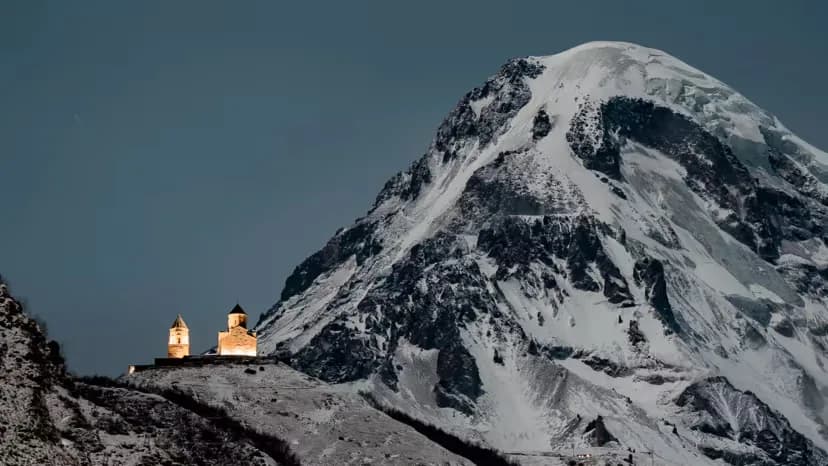
It's not that Kazbegi is the most technically dramatic mountain destination in the world. The Alps are higher. The Dolomites are more sculpted. Patagonia is wilder. But Kazbegi has something those places struggle to offer simultaneously: genuine remoteness and easy accessibility, medieval history embedded into the landscape, a mountain culture that hasn't been flattened by mass tourism, and a single image — the Gergeti Trinity Church on its impossible hilltop, Mount Kazbek rising behind it — that lives in the memory with unusual permanence.
The drive from Tbilisi takes three hours. You can leave after breakfast and be standing at 2,170 metres by midday. You can be back in the city for dinner.
This is the complete guide to doing it properly — the route, the stops, the hike, the food, the logistics, and why a private day trip with pickup from your hotel is the version worth doing.
The Georgian Military Highway: The Drive Is Half the Experience
The road from Tbilisi to Kazbegi follows the Georgian Military Highway — a route that has connected the Caucasus lowlands to the mountain communities of the north for over two thousand years. Persian traders used it. Mongol armies used it. The Russian Empire paved it in the 19th century and used it to consolidate control over the Caucasus. Today it's a well-maintained two-lane road that climbs from 400 metres above sea level in Tbilisi to over 2,300 metres at the Cross Pass, then descends into the Terek River valley and Kazbegi.
The landscape transformation along this drive is one of the most dramatic in Georgia. You leave Tbilisi through its northern suburbs, and within 30 minutes the city has disappeared entirely. The Aragvi River valley narrows ahead. Hills give way to mountains. The vegetation thickens, then thins as altitude increases. By Gudauri, you're above the treeline, in a high alpine plateau where the sky seems closer than it should.
On a clear day, the Cross Pass viewpoint opens onto a panorama of the Greater Caucasus that stops conversation. On a cloudy day, the clouds are below you — the mountain peaks emerging above a white sea — and it's somehow even better.
A private day trip means your driver stops when you want to stop. The best photographic moments on this highway happen spontaneously — a shaft of light through clouds, a shepherd crossing the road with his flock, a roadside waterfall appearing around a bend. With a private vehicle and a guide who knows the road, none of these are missed.
Every Stop Worth Making: The Complete Kazbegi Day Trip Route
Mtskheta — Georgia's Ancient Soul (30-40 minutes)
Twenty kilometres north of Tbilisi, where the Aragvi and Mtkvari rivers meet, sits Mtskheta — the ancient capital of the Kingdom of Iberia and the place where Christianity was introduced to Georgia in 337 AD. It is a UNESCO World Heritage site, one of the oldest continuously inhabited cities in the world, and a place of genuine spiritual significance for Georgians.
Most Kazbegi day trips include a brief Mtskheta stop, and it earns its place. Jvari Monastery — the 6th-century church on the hilltop above the confluence — offers one of the finest views in Georgia: the two rivers meeting below, the old town of Mtskheta in the middle distance, the mountains beginning on the horizon. The interior contains some of the oldest Christian frescoes in the Caucasus.
Svetitskhoveli Cathedral in the town center is Georgia's most sacred church — the burial place of Christ's robe, according to Georgian Orthodox tradition, and the site of coronations for Georgian monarchs for over a thousand years. Even for non-religious visitors, the scale and the atmosphere are remarkable.
Allow 30-40 minutes here. It's not a rushed stop — it's essential context for understanding why Georgia is the way it is.
Ananuri Fortress — Medieval Drama on the Reservoir (30-40 minutes)
An hour north of Tbilisi, the highway rounds a curve and Ananuri Fortress appears ahead — two medieval towers and a domed church rising directly from the turquoise waters of the Zhinvali Reservoir, backed by forested mountains on three sides. The combination of military architecture, Orthodox frescoes, and mountain reservoir setting is one of those Georgian images that seems too good to be real.
The fortress complex dates from the 16th-17th centuries and served as the stronghold of the Aragvi eristavi — the feudal lords who controlled this section of the military highway and extracted tolls from every trader, diplomat, and army that passed through. The history is turbulent: sieges, clan warfare, betrayals, massacres. Your guide brings it alive in a way that makes the stones speak.
Inside the larger tower, frescoes survive in surprisingly good condition given the fortress's violent history. The vine motifs, saints, and battle scenes tell the story of medieval Georgian Christianity in vivid colour.
Outside, the reservoir stretches south toward Tbilisi, its colour shifting from deep turquoise to milky jade depending on the light and season. The photographs from the fortress walls are consistently among the best of any Georgia trip.
Gudauri — The Roof of the Highway (20-30 minutes)
At 2,196 metres, Gudauri is Georgia's premier ski resort in winter and a high alpine plateau in summer — a broad, open landscape of mountain meadows and dramatic ridgelines that offers the first genuine sense of Caucasus scale on the drive north.
The stop here serves two purposes. First, the Soviet-era mosaic monument at the Cross Pass viewpoint — a circular structure depicting the Treaty of Georgievsk, the 1783 agreement between Georgia and Russia, in vivid Soviet-realist style. The monument itself is fascinating; the panorama from the viewpoint beside it is extraordinary — layers of Caucasus ridges extending north toward Russia, south toward Tbilisi, in every direction mountains.
Second, in summer months, the Gudauri plateau is blanketed in wildflowers — a carpet of yellow, purple, and white that makes the stop worth making for photography alone.
In winter, the Gudauri ski area is excellent by any international standard — modern lifts, well-maintained runs, fraction of the cost of Alpine resorts — and many travelers combine a Kazbegi day trip with a morning of skiing here during the winter months.
Kazbegi — Everything That Matters (3-4 hours)
The descent from Gudauri into the Terek River gorge is among the most dramatic sections of the highway — the road switchbacks down through a narrow canyon where the river charges through ancient rock and the walls rise vertically on both sides. Then the gorge opens, the valley widens, and Kazbegi appears: a small mountain town of a few thousand people, completely overwhelmed by its setting.
Mount Kazbek at 5,047 metres dominates the northern horizon. It's not the tallest mountain in the Caucasus — that's Elbrus, over the Russian border — but its profile is more perfect, its presence more immediate. On clear days, the summit glaciers catch the light in a way that makes the mountain seem luminous.
And above the town, on a rocky promontory at 2,170 metres, the Gergeti Trinity Church stands exactly as it appears in every photograph of Georgia you have ever seen.
The Gergeti Trinity Church: Hike vs 4x4 — Everything You Need to Know
This is the central question of the Kazbegi day trip, and it deserves a direct answer.
The Gergeti Trinity Church at 2,170 metres can be reached two ways: by 4x4 vehicle up a rough mountain track (20-30 minutes each way), or on foot via the hiking trail from Stepantsminda village (1.5-2 hours up, 1-1.5 hours down).
Both options are included in a private day trip with DayTourGuides.com. You choose on the day based on your preference, fitness, and available time.
The hike, honestly assessed: The trail gains 500 metres of elevation over roughly 2 kilometres. It is steep. There are sections of loose rock. In summer heat, it requires genuine effort. For reasonably fit adults with appropriate footwear, it is entirely manageable — but do not underestimate it in sandals or after a heavy lunch. The reward is proportional to the effort: arriving at the church on foot, lungs working, legs tired, produces a feeling of earned presence that the 4x4 route cannot replicate.
The 4x4 route: Rough, steep, and genuinely exciting — not a comfortable road by any measure. For travelers with mobility considerations, families with young children, or anyone who prefers to save their energy for exploring the church itself rather than reaching it, this is the right choice. The views from the vehicle track are excellent.
The honest recommendation: If you have the fitness and the footwear, hike up. Take the 4x4 down. You get the earned arrival, the extended time at the church, and legs that still function for dinner.
At the church itself: Built in the 14th century and still actively used for Orthodox services, Gergeti Trinity Church is austere, beautiful, and atmospheric in a way that goes beyond its architectural merit. The churchyard looks directly at Kazbek. On clear days, the mountain fills the entire northern sky — a wall of ice and rock so close it seems touchable. On cloudy days, the church emerges from mist. In either condition, it is a place that asks you to be quiet.
Allow at least an hour here. More if the weather is good and you're in no hurry.
Lunch in Kazbegi: What to Eat and Where
Mountain food in Georgia is distinct from Tbilisi food — heartier, more meat-forward, with influences from the Svan and Tushetian highland cultures to the west and north.
Kubdari is the essential mountain dish: a thick flatbread filled with spiced minced meat — pork, beef, or mixed — and baked in a wood-fired oven until the outside is crisp and the inside is steaming. The Svan spice mix (a blend of fenugreek, coriander, marigold, and chili) used in kubdari is unlike anything in lowland Georgian cooking. One kubdari between two people is a full meal.
Khinkali in the mountains are larger and more robustly filled than their Tbilisi counterparts — the soup inside is richer, the dough thicker. The correct technique remains: hold by the knot at the top, bite a small hole in the side, drink the broth, eat the rest. The knot is left on the plate. Do not eat the knot.
Locally brewed beer appears in Kazbegi in small family operations that produce unfiltered, yeasty, genuinely excellent lager-style beers. Nothing official, nothing labeled, everything good.
Your guide will choose the restaurant. This is not a city where Google reviews are reliable — the best places are known to locals, recommended by guides, and not prominently advertised. Trust the recommendation.
Private Day Trip vs Shared Tour: The Definitive Comparison
The Kazbegi day trip is available as a shared group tour (typically 10-15 people) or a private tour (your group only). Here is an honest comparison.
Shared tours cost less per person and are socially enjoyable if you're traveling solo and want to meet people. The trade-offs are real: fixed schedule, no spontaneous stops, a guide managing multiple people's questions simultaneously, and the Gergeti Church experience shared with the rest of your van.
Private day trips offer a different journey entirely. Your schedule is genuinely flexible — if the light is extraordinary at Ananuri and you want 20 more minutes, you have them. If you want to hike to Gergeti and everyone else in a shared tour wants the 4x4, there's no conflict. Your guide's entire focus is on your group. The vehicle is yours.
For couples and families, private tours are almost always better value than they appear — split across four people, the per-person premium over a shared tour is modest. For the quality difference, it's invariably worth it.
DayTourGuides.com private Kazbegi day trips include hotel pickup and drop-off, private vehicle, English-speaking guide, 4x4 transfer to Gergeti, all entrance fees, and Mtskheta and Ananuri stops.
Written by Author
Author