
Tbilisi to Mtskheta: A Half-Day Trip to Georgia's Capital
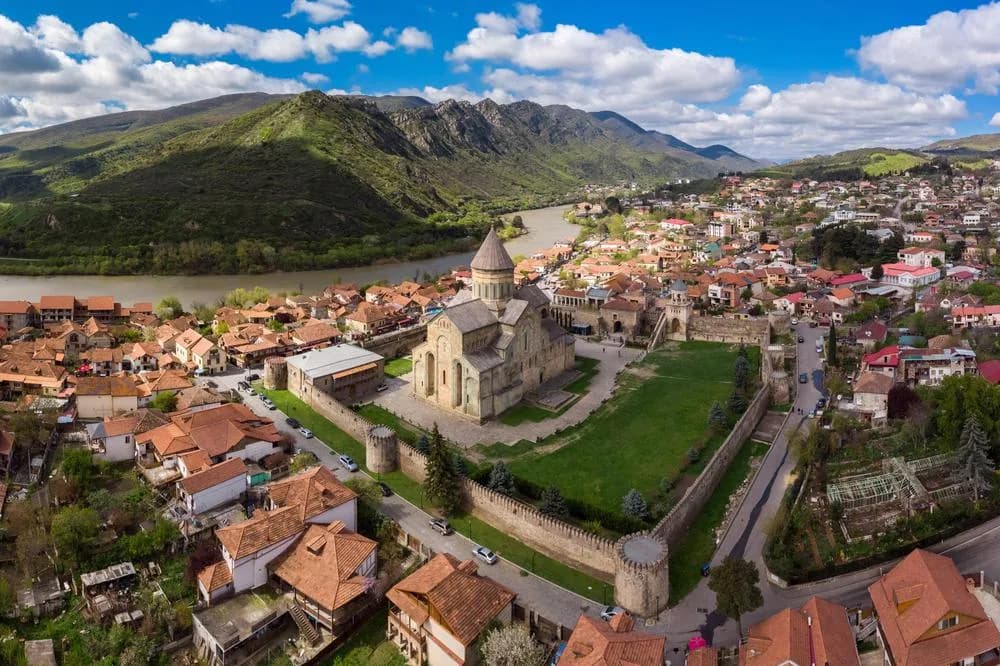
Some places carry their history lightly. Mtskheta is not one of them.
Standing at the confluence of the Mtkvari and Aragvi rivers, just 20 kilometers north of Tbilisi, Mtskheta has been continuously inhabited for over 3,000 years. It served as the capital of the ancient Kingdom of Iberia for nearly a millennium. It is where Christianity was officially adopted as Georgia's state religion in 327 AD. Its cathedral is said to contain the burial place of Christ's robe.
And yet somehow, despite all of this, Mtskheta remains one of the most underestimated half-day trips in the Caucasus — a place where history is not behind glass in a museum but embedded in living stone all around you.
Here is everything you need to know to make the most of it.
Mtskheta at a Glance
Distance from Tbilisi | ~20 km |
Drive time | ~25–35 minutes |
UNESCO Status | World Heritage Site (Historical Monuments of Mtskheta, 1994) |
Best visit duration | 3–5 hours |
Best combined with | Tbilisi city tour, Gori & Uplistsikhe, Kazbegi drive |
Entry fees | Most sites free; small fee for some museum areas |
A Brief History of Mtskheta
Mtskheta's story begins long before Christianity. The city served as the capital of the Kingdom of Iberia — the ancient Georgian state — from roughly the 3rd century BC until the 5th century AD, when the capital was moved to Tbilisi. Even after losing its political primacy, Mtskheta retained its spiritual authority as the seat of the Georgian Patriarchate and the symbolic heart of Georgian Orthodox Christianity.
The pivotal moment in its history came in 327 AD, when St. Nino of Cappadocia arrived in Georgia and converted King Mirian III and his court to Christianity. According to Georgian tradition, St. Nino fashioned her cross from grapevines bound with her own hair — the grapevine cross that remains the symbol of the Georgian Orthodox Church to this day.
The Robe of Christ — said to have been brought to Mtskheta by a Jewish Georgian named Elias who witnessed the Crucifixion — is believed to be buried beneath the ground where Svetitskhoveli Cathedral now stands, making it one of the most sacred sites in the entire Christian world.
What to See in Mtskheta
⛪ Svetitskhoveli Cathedral — The Living Pillar
There is no more important building in Georgia than Svetitskhoveli Cathedral.
Its name translates as "Life-Giving Pillar" — a reference to the miraculous cedar column that, according to Georgian hagiography, was built over the site where Christ's robe was buried. The column wept fragrant myrrh, healed the sick, and was incorporated into the first church on this site in the 4th century.
The current cathedral was built between 1010 and 1029 by the architect Arsukisdze — a magnificent example of medieval Georgian ecclesiastical architecture, its soaring interior decorated with frescoes, its walls bearing centuries of royal tombs. Seven Kings of Georgia are buried within its walls.
Outside, the cathedral is enclosed by a fortified wall with distinctive square towers — an architectural reminder that in medieval Georgia, sacred and military concerns were rarely separate.
What to notice inside:
The Pillar of Life — a structure within the cathedral marking the sacred burial site, covered in elaborate carved stone decoration
The tomb of Vakhtang Gorgasali — the king who moved Georgia's capital to Tbilisi in the 5th century
Medieval frescoes in varying states of preservation across the interior walls
The extraordinary carved stone facade of the south entrance
Practical notes: Dress modestly (shoulders and knees covered; women should cover their hair inside). The cathedral is an active place of worship — be respectful of services in progress.
⛪ Jvari Monastery — The Cross on the Hill
If Svetitskhoveli is Mtskheta's heart, Jvari is its soul — and its most dramatic image.
Perched on a rocky promontory directly above the confluence of the Mtkvari and Aragvi rivers, Jvari Monastery was built in the late 6th century on the site where St. Nino is said to have erected a large wooden cross that performed miracles. The current church, built between 586 and 605 AD, is one of the finest surviving examples of early medieval Georgian architecture — small, severe, and geometrically perfect.
The view from Jvari's terrace is one of the defining images of Georgia: Mtskheta laid out below, the two rivers meeting in a visible line of contrasting colors (the darker Mtkvari and the clearer Aragvi), the green valley stretching away toward Tbilisi, and the distant mountains closing the horizon.
The Russian Romantic poet Mikhail Lermontov was so moved by this view that he set his poem Mtsyri (The Novice) here — and his lines about the Aragvi and Mtkvari confluence are arguably the most famous description of this landscape ever written.
Getting to Jvari: It sits ~4 km from central Mtskheta by road — a short taxi or car ride up the hill. The view on the way up, looking back toward the town and river, is already spectacular.
🏛️ Samtavro Monastery & the Tomb of King Mirian
On the northern edge of Mtskheta's old town, Samtavro is a working nunnery built around a small but historically significant church. Within its grounds lie the tombs of King Mirian III and Queen Nana — the royal couple converted by St. Nino, whose acceptance of Christianity in 327 AD made it the state religion of Georgia, making these arguably the most historically significant graves in the country.
The small Transfiguration Church on the grounds occupies the spot where St. Nino lived and prayed during her time in Mtskheta. Its atmosphere — candlelit, fragrant with incense, inhabited by nuns going about their devotions — is genuinely affecting.
🏛️ Mtskheta Old Town & the Antikvariatebis Bazroba
Between the major monuments, Mtskheta's small old town rewards unhurried wandering. The main street is lined with stalls selling churchkhela, local honey, amber jewelry, and handmade crafts — touristy, yes, but the quality of some handicrafts is genuinely good and prices are fair by Georgian standards.
Several small restaurants along the main street serve excellent traditional Georgian food. Stop for khinkali and local wine before or after your monastery visits.
Suggested Half-Day Itinerary
9:00am — Depart Tbilisi by car or guided tour 9:30am — Arrive Mtskheta. Begin at Svetitskhoveli Cathedral (allow 45–60 min) 10:30am — Walk to Samtavro Monastery (allow 30 min) 11:00am — Drive up to Jvari Monastery (allow 45 min including viewpoint time) 12:00pm — Return to Mtskheta old town for lunch at a local restaurant 1:30pm — Browse the market, pick up churchkhela and local honey 2:00pm — Return to Tbilisi, or continue to Gori/Uplistsikhe for a full day
Combining Mtskheta With Other Destinations
Mtskheta's proximity to Tbilisi and its position on the main highway north makes it a natural addition to several day trip routes:
Mtskheta + Gori + Uplistsikhe — A full-day history circuit covering ancient, medieval, and Soviet-era Georgia. One of the most rewarding day trips available from Tbilisi.
Mtskheta + Kazbegi — Stop at Mtskheta on the way to or from Kazbegi for a perfect single-day combination of spiritual history and mountain scenery.
Mtskheta + Ananuri + Gudauri — If you're heading north and want to maximize the Georgian Military Highway, add Mtskheta as your first stop before continuing toward the mountains.
Mtskheta in Spring
April is one of the loveliest times to visit Mtskheta. The hillside around Jvari is green and fresh, the fruit trees in the valley below are blossoming, and the light on the Aragvi-Mtkvari confluence is at its most luminous in the morning hours.
Easter (late April in 2026) brings particularly moving ceremonies to both Svetitskhoveli and Samtavro — candlelit services, processions, and a genuine sense of living tradition that connects the present moment to the city's 1,700-year Christian history.
Practical Information
Getting there | Car, taxi, marshrutka from Didube station, or guided tour |
Best time to visit | Morning (fewer tour groups, better light at Jvari) |
What to wear | Modest clothing; women bring a headscarf for church interiors |
Photography | Permitted outside; ask before photographing inside active churches |
Facilities | Restaurants and cafés in the old town; limited near Jvari |
Languages | Georgian and Russian most common; English in tourist areas |
Visit Mtskheta With a Local Guide
The stones of Mtskheta hold extraordinary stories — but without context, they are just stones. Our Mtskheta guided tours bring the city's 3,000-year history to life, connecting the architecture, the legends, and the living faith that makes this one of the most layered and rewarding destinations in all of Georgia.
Have you visited Mtskheta? What moved you most? Share in the comments below.
Written by Author
Author