
Uplistsikhe & Gori Day Tour: Cave City and Stalin Museum
An hour and a half west of Tbilisi, two very different attractions sit fifteen kilometers apart — one a 3,000-year-old city carved entirely from rock, the other a museum dedicated to the most controversial Georgian in history. Together, the Uplistsikhe and Gori day tour covers a sweep of time from the Iron Age to the 20th century, and each site provokes questions the other can't answer alone.
Uplistsikhe: Georgia's Ancient Cave City
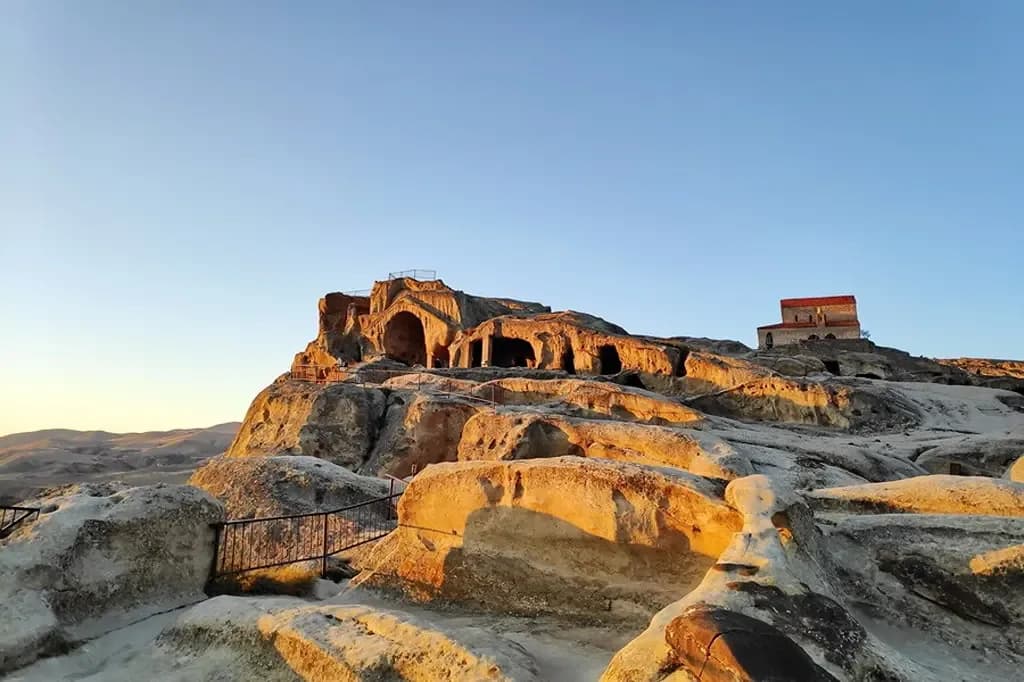
Uplistsikhe (meaning "Lord's Fortress") is carved into a rocky ridge above the Mtkvari River, and it has been inhabited on and off since roughly 1000 BC. At its peak during the early medieval period, the city held approximately 20,000 people — living, trading, and worshipping in structures cut directly from sandstone.
What You'll See
Walking through Uplistsikhe is like moving through geological time. The oldest sections — crude chambers and tunnels at the base of the rock — date to the late Bronze and early Iron Age. Higher up, more refined spaces show Hellenistic influence: a large hall with carved columns (the "theater"), a ceremonial hall with coffered ceilings imitating Greek wooden architecture, and a pharmacy where ancient healers stored medicines.
The 10th-century Basilica church, built on the highest point after the city converted to Christianity, provides a timeline marker — traditional pagan structures below, Christian additions above, and the whole complex telling the story of how Georgian culture evolved.
Walking the Site
The path through Uplistsikhe takes 60–90 minutes. Some sections involve climbing through narrow rock tunnels and stepping over uneven surfaces. Wear sturdy shoes — sandals are genuinely impractical here. There are no handrails in most areas, so keep children close in the steeper sections.
A secret tunnel carved through the rock once provided emergency access to the river below. You can see its entrance (now partially collapsed) near the eastern edge of the complex.
Practical Details
The site is open daily. Entry costs about 7 GEL, and an audio guide is available for an additional fee. A guided tour adds essential context. Without explanation, you're looking at interesting rocks. With a guide, those rocks become a sophisticated ancient civilization.
Gori: The Stalin Museum
Gori, the regional capital, is a quiet city whose modern identity is inextricably linked to one fact: Joseph Stalin was born here in 1878.
The Museum
The Stalin Museum is one of the most unusual — and debated — museum experiences in the Caucasus. Established in 1957, four years after Stalin's death, it presents an extensive collection of personal items, photographs, documents, and gifts from world leaders. The displays include Stalin's personal railway carriage (armored, with a bathtub), his death mask, and a recreation of the modest house where he was born.
The museum's presentation has drawn criticism for offering a largely uncritical narrative — there's limited acknowledgment of the purges, gulags, or the estimated millions who died under his rule. This absence is itself informative. The museum isn't really about historical accuracy; it's about understanding how Soviet-era memorialization worked and how local identity can be shaped by a single figure.
How to Approach It
Go with curiosity rather than expectations. The museum is most interesting when viewed as an artifact of Soviet propaganda rather than as a reliable historical source. Many tours include a guide who provides the missing context — the political repression, the deportations of ethnic groups, and the human cost of industrialization policies.
Combining Uplistsikhe and Gori
The two sites are 15 kilometers apart, and most organized day tours visit both in a single trip, typically spending 90 minutes at Uplistsikhe and 60 minutes at the Stalin Museum. The round trip from Tbilisi takes 7–8 hours including travel time.
Some tours add Mtskheta as a third stop, since it lies on the route between Gori and Tbilisi. This combination — cave city, museum, and UNESCO heritage — makes for a comprehensive historical day.
Getting There Independently
By marshrutka: Regular minibuses from Tbilisi's Didube station reach Gori in about 1.5 hours. From Gori, a taxi to Uplistsikhe costs approximately 20–25 GEL round trip with waiting time.
By train: Trains run from Tbilisi to Gori several times daily, taking about an hour. The train station is in the center of Gori, a short walk from the museum.
What to Eat in Gori
Gori's food scene is unpretentious and satisfying. Look for local restaurants serving shkmeruli (chicken in garlic cream sauce — a dish that originated in this region), lobiani (bean-filled bread), and khinkali. Prices are lower than Tbilisi, and portions tend to be generous.
Frequently Asked Questions
How old is Uplistsikhe?
The earliest traces of habitation date to approximately 1000 BC, making it around 3,000 years old. The site was most actively inhabited from the 6th century BC to the 13th century AD.
Is the Stalin Museum glorifying Stalin?
The museum presents Stalin's life with minimal critical commentary, which some visitors find uncomfortable. It's best understood as a historical document of Soviet-era memorialization rather than a balanced biography. Good guides address the context that the museum omits.
Is Uplistsikhe accessible for people with mobility issues?
The site involves climbing uneven rock surfaces and narrow passages. It's not wheelchair accessible, and visitors with significant mobility limitations may find the terrain challenging. The lower sections are more accessible than the upper caves.
Can I combine Uplistsikhe with other day trips?
Uplistsikhe-Gori pairs well with Mtskheta (on the return route to Tbilisi). Combining it with Kazbegi in one day is not practical due to distances. For planning, consult our Georgia itinerary guide.
Step into 3,000 years of Georgian history. Book an Uplistsikhe and Gori day tour — with expert guides who bring the stones to life.
Written by Author
Author