Canyons & Nature
David Gareja Monastery: A Desert Adventure from Tbilisi
Author

Loading
Preparing your travel experience.
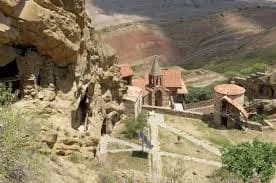
Two hours southeast of Tbilisi, the landscape transforms in a way that feels almost impossible. The green valleys and forested hills give way to semi-arid steppe — rolling, treeless terrain where the only interruptions are distant ridgelines and the occasional shepherd with a flock. And then, carved into the face of a long rocky ridge on the Azerbaijan border, appears one of Georgia's most extraordinary sites: the David Gareja monastery complex.
This isn't a polished tourist attraction. There are no souvenir shops, no restaurants at the entrance, and no audio guides. What there is: a 6th-century monastic settlement stretching six kilometers along a ridge, cave cells where monks lived in isolation for centuries, and frescoes painted a thousand years ago that still hold their colors in the desert light.
David Gareja was founded in the 6th century by David Garejeli, one of the Thirteen Assyrian Fathers — a group of monks who traveled from Mesopotamia to Georgia to strengthen the Christian faith. David chose this remote, inhospitable ridge precisely because of its isolation — the harsh landscape was considered ideal for spiritual contemplation.
Over the following centuries, the complex grew to include roughly 15 monasteries spread along the ridge. At its peak, it was one of the most important monastic centers in the Caucasus, producing manuscripts, icons, and generations of scholars. Mongol invasions, Persian raids, and Soviet neglect took their toll, but the core structures survived — in some cases, because they were literally carved into stone that conquerors couldn't dismantle.
The first section you'll visit, the Lavra, is the most accessible. It's built into the hillside at the base of the ridge and remains a functioning monastery — a small community of monks still lives here.
The courtyard contains David Garejeli's tomb (covered by a chapel), a refectory, and monk's cells arranged around a compact enclosure. The atmosphere is quiet and contemplative, even when visitors are present.
The real reward comes from climbing over the ridge to reach the Udabno section on the southern face. The trail from the Lavra parking area takes 30–45 minutes of moderate hiking — uphill, exposed, and potentially hot in summer. There's no shade on the ridge trail, and the sun is intense.
What waits on the other side justifies every step. The Udabno caves contain frescoes dating from the 10th to 13th centuries — painted directly onto cave walls in colors that, sheltered from rain by the overhang of rock, have survived remarkably well. Scenes depict the Last Supper, the Ascension, and various saints, rendered in a style that blends Byzantine tradition with distinctly Georgian artistic sensibilities.
The caves are open to visitors, and you can walk between them along narrow paths cut into the cliff face. Looking out from the cave openings, the view stretches across the semi-desert into Azerbaijan — a landscape so vast and empty it seems to belong to a different continent.
There is no public transport to David Gareja. Your options:
Organized day tour: The simplest solution. Group and private tours from Tbilisi include transport, a guide, and often combine David Gareja with other stops. The drive takes approximately two hours each way.
Private car/taxi: Hire a taxi for the day from Tbilisi (expect 150–200 GEL round trip). The road is paved most of the way, with the last 20 km on a gravel road that's manageable for regular cars in dry conditions. In wet weather, a higher clearance vehicle is recommended.
Spring (March–May): The best season. The steppe briefly blooms with wildflowers, temperatures are comfortable for hiking, and the light is beautiful.
Autumn (September–October): Warm but not brutal. The golden-brown landscape has its own stark beauty.
Summer (June–August): Extremely hot. Temperatures at the ridge regularly exceed 35°C, and there is zero shade on the Udabno trail. If visiting in summer, depart Tbilisi by 7 AM to reach the ridge before peak heat.
Water (minimum two liters per person — there is no water source at the site), sun protection (hat, sunscreen, sunglasses), sturdy shoes (the trail is rocky and uneven), snacks (no food vendors at the complex), and a warm layer (wind on the ridge can be cold even on warm days).
Part of the David Gareja complex, including some of the Udabno caves, sits along the disputed Georgia-Azerbaijan border. Access to certain sections may be restricted depending on current diplomatic conditions. Tour operators stay informed about access status and will adjust itineraries accordingly.
Is David Gareja worth the trip from Tbilisi?
If you appreciate historical sites in raw, undeveloped settings — absolutely. David Gareja offers something no other Georgian destination matches: the combination of ancient art, desert landscape, and genuine remoteness.
How difficult is the hike to Udabno caves?
Moderately challenging. The trail climbs about 200 meters over 2 km. The terrain is rocky but well-marked. Heat is the main difficulty in summer — start early and carry plenty of water.
Is there an entrance fee?
Access to the Lavra and Udabno caves is free. There's no ticket office or formal entrance.
Can I visit David Gareja in one day from Tbilisi?
Yes — the standard tour departs Tbilisi in the morning and returns by late afternoon. A full day is sufficient to see both sections comfortably. See our day trips from Tbilisi guide for other excursion options.
Discover Georgia's hidden desert monastery. Book a David Gareja day tour — with transport, a guide who brings the frescoes to life, and plenty of time to explore.
Written by Author
Author